Termite Baiting: When it works (and when it doesn’t)

In the Brisbane pest control industry, there is a lot of noise about termite baiting systems. Some companies claim they are the “only” solution, while others dismiss them entirely in favour of chemical barriers.

At Conquer Termites, we believe in transparency. The truth is that termite baiting is a sophisticated tool – but like any tool, it’s only effective when used in the right circumstances.

If you are trying to decide between a full termite baiting program and a liquid chemical barrier (like Termidor), this guide explains exactly when baiting is your best friend and when it might leave your home vulnerable.

How Termite Baiting actually works

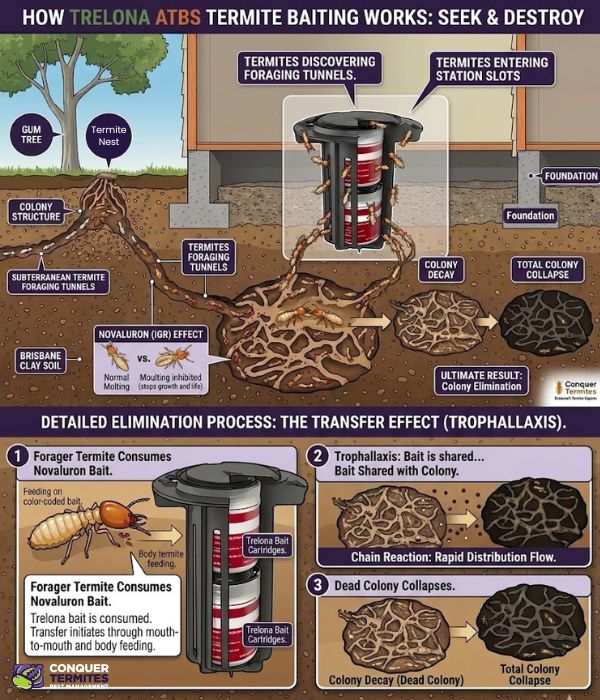
Unlike a chemical barrier, which creates a treated “zone” in the soil to keep termites out, a baiting system is a “seek and destroy” mission. We utilise the Trelona ATBS (Advanced Termite Baiting System) for its superior performance in Brisbane conditions.

  1. Interception (In-Ground): We install discreet Trelona stations around your home’s perimeter. These contain highly palatable cellulose “interceptors.”
  2. Feeding: Foraging termites find the stations. Trelona bait is scientifically proven to be more attractive to termites than the timber in your home.
  3. Elimination: The bait contains Novaluron (an IGR). Termites carry this back to the nest, sharing it with the colony. It stops them from moulting, eventually leading to total colony collapse.
A diagram how Trelona Bait station works
  • When termite baiting works best

1. Difficult Construction Types (The “Brisbane High-Set”)

If your home is built on a steep slope, has “split levels,” or sits on nested sandstone or heavy rock, trenching for a continuous chemical barrier can be impossible. In these cases, a baiting system is the most reliable way to protect the structure without digging deep trenches.

2. High-Pressure Areas (Near Bushland)

If your property backs onto a creek, parkland, or has large gum trees (like in The Gap, Chapel Hill, or Upper Kedron), you are in a high-pressure zone. Baiting systems work brilliantly here because they actively reduce the local termite population rather than just trying to block them.

When used in combination with a chemical treatment, it provides the ultimate protection from termites.

3. Environmentally Sensitive Sites

If you have a heavy organic garden, a high water table, or you are simply concerned about the volume of liquid chemicals used in a traditional liquid chemical barrier, baiting is the preferred “green” choice. The active ingredients are contained within the stations and are non-toxic to pets and humans.

4. Active Infestations (Above-Ground Solutions)

When we find live termites inside a wall, we use Above-Ground (AG) Bait Stations. This is a very effective way to stop them from eating your house right now by giving them a food source they prefer over your structural pine or hardwood. Once the internal colony is eliminated, we transition to an external In-Ground system.

  • When termite baiting doesn’t work (The limitations)

1. The “Patience” Factor

Baiting is a biological process. It can take 3 to 6 months for a colony to collapse fully. If you have a massive infestation and want immediate “kill” results, a chemical barrier or a “dual-system” approach may be required.

2. Low-Activity Colonies

Baiting relies on termites “finding” the stations. If a colony is small or very timid, they may ignore the stations for a period. This is why station placement and professional monitoring are more important than the brand of the bait.

3. Neglected Maintenance

A baiting system is not “set and forget.” To be effective, stations must be checked on a professional cycle – usually every 60 to 90 days, depending on the activity levels. If the stations aren’t checked and replenished, termites can consume all the bait and move on to your house.

Tip: A termite baiting system can look cheaper to install than a Termidor HE chemical treatment. But when you add the cost of ongoing quarterly monitoring visits for the whole system, it can become significantly more expensive over time.

How Foraging Termites Enter Brisbane Homes

In Brisbane, termite pressure isn’t occasional – it’s constant. In most suburbs across South East Queensland, there are multiple active termite colonies in the ground at any given time, all foraging in search of a food source. And unfortunately, your home is exactly what they’re looking for.

Subterranean termites don’t randomly appear inside a house. They work methodically, travelling underground through the soil, often over distances of 50 metres or more from their nest. As they forage, they locate timber and begin to exploit the smallest concealed entry points into a structure.

Adding to the risk, Brisbane’s warm, humid climate allows termites to remain active all year round. There is no “off season.” Combined with the high density of timber structures across our suburbs, this creates an environment where termite pressure is not just likely – it’s inevitable.

This is exactly why termite baiting systems are so effective. Instead of trying to guess where termites might enter, baiting works by intercepting foraging termites in the soil before they reach your home – targeting the problem at its source.

Summary: Is it right for you?

Feature Baiting System (Trelona) Chemical Barrier (Termidor)
Primary Goal Colony Elimination Stop Multiple Termite Entry
Installation Non-invasive (*Core cutting) Invasive (Trenching/Drilling)
Speed 3–6 Months to Colony Elimination Immediate Protection
Maintenance Professional Checks (Every 60-90 Days) Annual Inspection – Long-term 8 Years
Best For Complex builds / Deep footings Slab-on-ground / concrete paths

Get a site-specific recommendation

Don’t guess with your biggest asset. Every Brisbane property is different.

Speak with a termite specialist – not a call centre. With an inspection. We’ll assess your home’s construction, soil type and local termite pressure to tell you exactly which system will actually work for your home.

  • Call us NOW

Same day response – Monday to Friday

We’ll get out to you today

We cover all homes on the Northside, Southside, and Bayside

  • Send us a photo to identify 

If you’ve found a bug and need to know right now if it’s a termite

Not sure if it’s termites or ants? Our team can help identify what you’re seeing before it becomes a bigger problem.