
Understanding the limitations of initial termite treatments

When you discover termites in your home, the first priority is to stop the immediate activity. This is often done by doing an initial termite treatment, sometimes called a spot or localised treatment.

These treatments target the specific area where termites are active, helping to stop the damage quickly. However, a localised treatment only addresses the known activity. The termite colony may still exist in other areas of the structure.

In Brisbane and South East Queensland, a complete termite management system is required to properly protect the home.
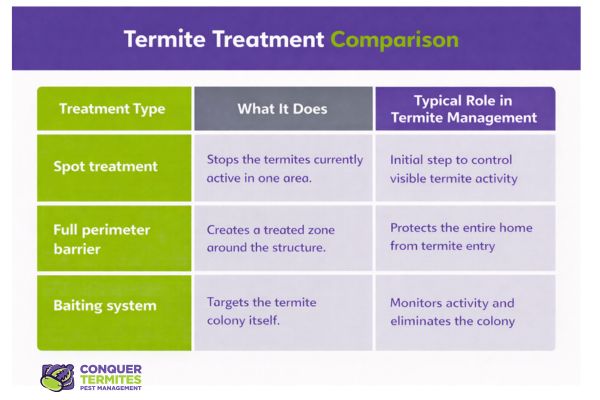
A spot treatment can stop the termites you see today – but protecting the entire home requires a complete termite management system

What a spot termite treatment does

A spot termite treatment (also called a localised or initial termite treatment) is often used to control active termites before installing a full termite management system.

This may involve treating:

  • A wall cavity where termites have been discovered
  • A door frame or window frame showing termite damage
  • A single termite lead or mud tunnel
  • A termite mud lead or entry point
  • A small soil area where termites are entering the home

The goal of this initial treatment is to interrupt the immediate termite activity and reduce the risk of further damage in that location.

This is why localised treatments are often carried out as the first stage of termite management.

  • Why localised treatments alone do not fully protect a home

Subterranean termites live in large underground colonies, often metres away from the house they are attacking.

In many homes built on concrete slabs, termites can gain concealed access from the soil along the external perimeter. This means there may be multiple hidden entry points around the structure, not just the area where termite activity was first discovered.

Because of this, treating only the visible termite activity does not necessarily prevent termites from:

  • Entering the building from another side of the home
  • Finding a new concealed entry point
  • Continuing to forage in untreated areas of soil near your home
  • Re-entering the structure months later

For this reason, professional termite management normally involves more than just treating the immediate problem area.

Real-World example: How termites can reappear

Scenario 1: Termites in a wall cavity

A homeowner discovers termites in a bedroom wall.

A technician treats the wall cavity to eliminate the termites in that area.

The immediate activity stops.

However, several months later, termites appeared in another part of the house, because the underlying colony in the soil was never managed.


Scenario 2: Treating a single entry point

Termites are discovered entering a home through a garden bed.

The entry point is treated successfully.

But termites later appear on the opposite side of the house, entering through a concealed crack in the slab.

Again, the initial treatment was successful in that location, but the overall termite pressure around the home remained.

How termites enter homes

Subterranean termites are capable of entering buildings through extremely small concealed gaps.

Common termite entry points include:

  • Slab expansion joints

Small construction joints in concrete slabs can allow termites to enter unseen.

  • Cracks in concrete or brickwork

Even minor structural cracks can provide concealed access.

  • Plumbing and service penetrations

Pipes, drainage points and conduits can create hidden entry pathways.

  • Garden beds against external walls

Moist soil and landscaping timber can attract termites close to the structure.

  • Subfloor areas

Homes with suspended floors often provide numerous concealed entry points.

  • Call us NOW

Same day response – Monday to Friday

We’ll get out to you today

  • Send us a photo to identify 

If you’ve found a bug and need to know right now if it’s a termite

Not sure if it’s termites or ants? Our team can help identify what you’re seeing before it becomes a bigger problem.

The next step (most important one): Installing a complete Termite Management System

Once the initial termite activity has been controlled, the next step is to install a long-term termite management system designed to protect the entire building.

This may involve:

Full perimeter termite treatments

Products such as Termidor HE can be applied to the soil around the home to create a continuous treated zone.

This helps prevent termites from entering the structure and allows the product’s transfer effect to impact the colony.


Termite baiting systems

In some situations, baiting systems may be installed around the property to target the termite colony itself.

These systems allow technicians to monitor termite activity and gradually eliminate the colony.


Ongoing termite inspections

Regular termite inspections remain essential, particularly in Brisbane, where termite pressure is high year-round.

Annual inspections help ensure early detection of any new activity.

Some useful links for you to understand the recommended process

Once termites have been identified, the correct approach usually involves a termite inspection, an initial treatment, and a long-term termite management system. Learn more about each step below.

In summary: Why professional termite management matters

Termite treatments should not simply remove the termites that are visible today.

A proper termite management strategy aims to:

• Stop the immediate termite activity
• Identify potential entry points
• Protect the entire structure
• Reduce the risk of future infestations

This is why experienced termite professionals recommend a staged approach to termite management, beginning with an initial treatment and followed by a comprehensive protection system.